Lebanon’s Breaking Point: Stunning Iran Ceasefire Shift


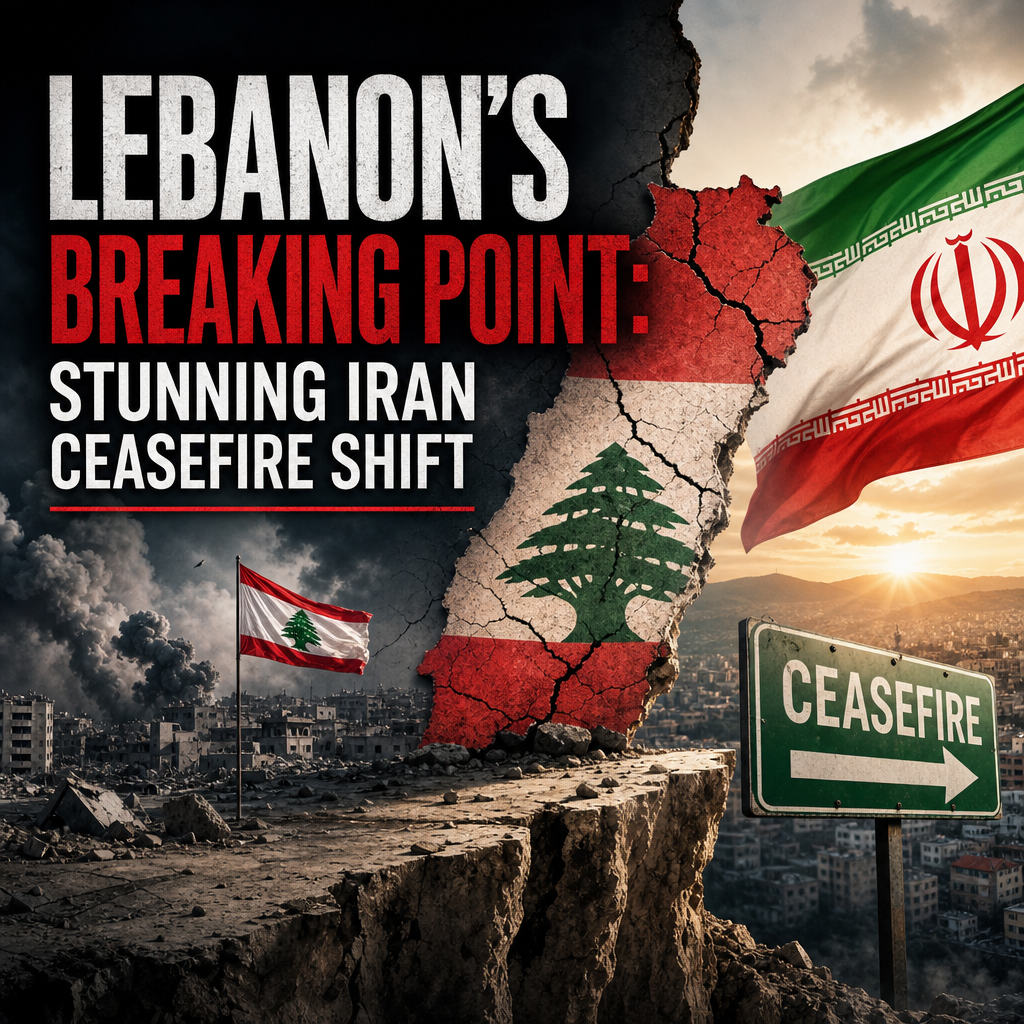
Lebanon’s breaking point has become a test of how fragile any Iran-related ceasefire really is, because the country sits at the intersection of regional proxy politics, domestic collapse, and the constant risk that a border flare-up could widen into something much bigger.
What stands out from the coverage across Al Jazeera, Sky News, and RT is not a single neat explanation but a shared sense that Lebanon is no longer just a side theater. It is a pressure valve. When tensions involving Iran, Israel, Hezbollah, and the United States rise, Lebanon is often where the consequences become visible first: displacement, airstrikes, political paralysis, economic anxiety, and arguments over who can actually enforce restraint.



Lebanon’s breaking point in the Iran ceasefire equation
The phrase “Lebanon’s breaking point” matters because it captures a country already stretched thin before any fresh regional escalation. Lebanon’s economy has been battered for years, public institutions remain weak, and the government has limited room to maneuver. In that context, even a temporary ceasefire or de-escalation elsewhere can feel unstable if the Lebanese front remains active.
Al Jazeera’s reporting frames Lebanon as central to the wider conflict architecture, suggesting that the country’s vulnerability is not accidental. Hezbollah’s military and political role means Lebanon is tied to Iran’s deterrence strategy, while Israel views cross-border attacks as a direct threat. That leaves Lebanese civilians caught between powers that are often making decisions far beyond Beirut’s control.




Sky News tends to emphasize the immediate human and geopolitical stakes: ceasefires are only meaningful if they hold where the danger is highest. In practical terms, that means the Lebanese border. If the fighting there pauses while deeper tensions remain unresolved, the pause may be less a resolution than a timeout. That is why analysts keep returning to the same concern: a ceasefire can reduce the temperature, but it does not automatically remove the heat source.
RT’s coverage, meanwhile, generally pushes readers to see the conflict through a broader anti-Western or anti-intervention lens, often highlighting the role of Washington and allied pressure in shaping events. From that viewpoint, Lebanon is not merely collateral damage but evidence of a regional order in which outside powers influence outcomes while local states absorb the costs. Even if one does not accept RT’s framing wholesale, it does underscore a real point: Lebanon’s crisis is inseparable from external rivalries.
Why Lebanon matters more than it should
Lebanon matters because it combines several dangerous ingredients:
– a powerful non-state armed actor with regional ties
– a border with Israel that can ignite quickly
– a deeply weakened state unable to fully control escalation
– a civilian population already exhausted by economic and political crisis
– competing international narratives that make compromise harder to sell
That combination turns Lebanon into more than just a front line. It becomes a credibility test. If ceasefire diplomacy cannot prevent spillover there, then any broader regional agreement looks brittle.
A ceasefire shift, but not necessarily a lasting turn
The surprising part of the reported ceasefire shift is not that leaders want de-escalation; it is that de-escalation seems possible at all after so much mutual escalation. Yet the sources also suggest caution. None of the reporting implies that the underlying disputes have been solved. Instead, they point to a recalibration: military pressure, diplomatic signaling, and domestic exhaustion may be nudging the parties toward temporary restraint.
That is where the contrast between the outlets is useful. Al Jazeera often highlights the political and humanitarian dimensions, reminding readers that civilians pay the price when armed groups and states trade messages through force. Sky News is more likely to focus on whether the truce is credible, enforceable, and likely to survive the next incident. RT, by contrast, often treats the crisis as proof that Western-led security arrangements are failing or hypocritical.
Taken together, those perspectives point to the same uncomfortable conclusion: a ceasefire shift may be real, but it is probably tactical rather than transformative.
What the sources agree on
Despite their different angles, the reporting converges on a few important facts and warnings:
– Lebanon is a critical pressure point in the Iran-Israel confrontation.
– Any ceasefire that ignores Lebanon is incomplete.
– Hezbollah’s role makes Lebanese sovereignty politically complicated.
– Civilian risk remains high even during periods described as “calm.”
– The region’s larger diplomatic order is too unstable for easy confidence.
That consensus matters because it helps separate wishful thinking from real progress. A ceasefire that pauses major attacks can save lives, but if it leaves the underlying regional contest intact, the peace may only be temporary.
The bigger question: can Lebanon escape being the fuse?
The hardest truth is that Lebanon’s problem is not just geography; it is dependency. It depends on regional actors for stability, aid, deterrence, and even political bargaining power, while those same actors often benefit from Lebanon’s vulnerability. That makes it easy for outside powers to treat the country as leverage and difficult for Lebanese institutions to act independently.
The fair conclusion, based on the sources, is that Lebanon is both a warning and a barometer. If it remains calm, it may signal that the broader Iran-related confrontation is being contained. If it destabilizes again, it could expose how shallow any ceasefire truly was.
For now, the shift toward restraint should be welcomed, but not romanticized. Lebanon’s breaking point has shown that ceasefires in this region are only as strong as the weakest border, the least controlled militia, and the most anxious civilian population. That is not a formula for lasting peace. It is a reminder that the next crisis may already be waiting just beneath the surface.